
Posts

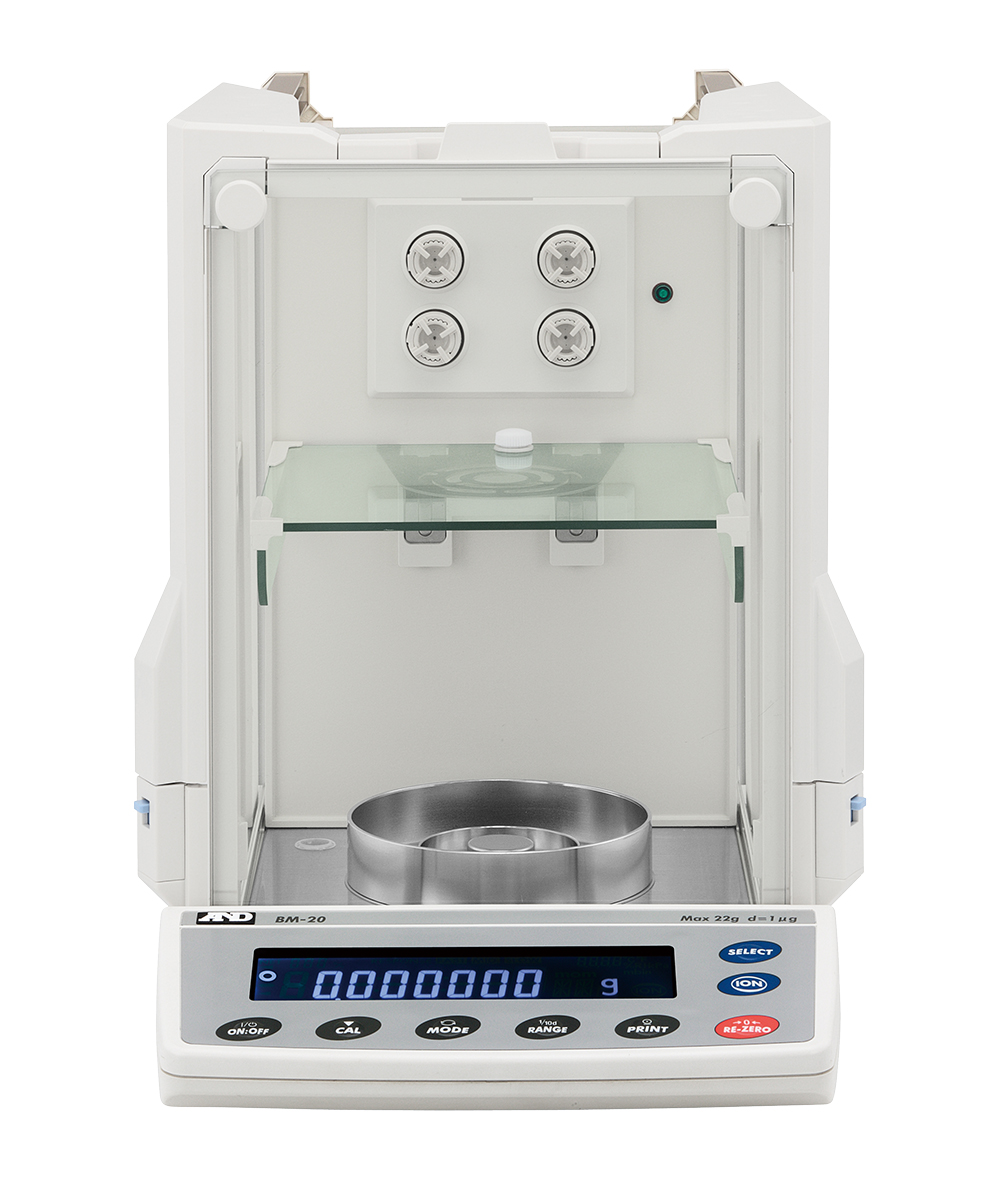
The BM Series of micro-balances went on sale in December 2010 as A&D’s flagship line of analytical balances. The BM Series was considered a flagship line not because they are the only micro-balances made in Japan. We envisioned this series being used for research, development, and analysis in leading-edge fields in Japan. Our development objectives were 1) anti-static countermeasures and 2) the documentation of weighing performance in user environments. The “Development Stories” series will describe in detail how these objectives were met, including the processes used to arrive at the solutions. This installment covers countermeasures for static electricity and the next installment will cover the documentation of weighing performance in user environments.

When we investigated the needs for micro-level weighing during the planning stage of the BM Series, we found that microgram-level measurement is currently required with the following types of samples.

1.  Minute amounts of powders in the analysis of pharmaceuticals and food additives

2.  Samples placed in plastic containers such as microfuge tubes using micro-pipettes in bio-research and the quantitative analysis of protein

3.  Samples placed on drug packing paper in pharmaceutical fields

4.  Particulates trapped by filters made of Teflon (PTFE) and similar materials to measure environmental pollutants in the air

5.  Minute amounts of liquid ejected from dispensers in production lines for liquid crystals, LEDs, and electronic parts

The use of micro-balances in such applications can be difficult because powders, plastic containers, drug packing paper, and Teflon filters can become electrostatically charged very easily. Additionally, sample weights are usually 10 mg or less, and a minimum display of 0.01 to 0.001 mg, and in some cases 0.0001 mg, is required. For reference, 0.001 mg, or 1 microgram, is one millionth the weight of a paper clip (1 g). Since static electricity can cause weighing errors of several tens of milligrams, it is impossible to weigh at the micro level without first dealing with static electricity.

The minute amounts being measured in the abovementioned micro-level weighing applications require a balance with very acute sensitivity (minimum display) and the effects of electrically-charged samples and containers make it impossible to perform accurate weighing. Micro-balances are also used to measure minute amounts of liquid, powders, and solids in production lines in clean rooms dehumidified to a humidity of 0% to maintain quality. Most clean rooms must be free of dust and metallic contaminates so material such as polyoxymethylene (polyacetal) is frequently used in drive systems to reduce both slide resistance and the release of metallic particles. However, plastic is easily charged in low humidity. For example, vials and other weighing containers can become charged during delivery, which causes unstable weighing and other problems.

To eliminate static electricity, all models of the BM Series are equipped as standard with a direct-current ionizer. Direct-current ionizers generate a large number of ions over a wide area so they do not require a fan to blow the ions, which means that powder samples do not get blown away. What’s more, the strong anti-static performance of direct-current ionizers removes static electricity from samples in about 1 second, which means the breeze break door only has to be opened and closed once while eliminating static electricity and weighing the sample. Additionally, the balances are equipped with a dedicated anti-static chamber. Users can place samples here to eliminate static electricity from all samples before weighing. This allows the user to weigh the samples one after another without having to perform static elimination before each weighing. Storing samples before weighing in the anti-static chamber not only removes static but also allows samples to acclimate to the temperature of the weighing chamber. This reduces convective flow, which can be caused by temperature differences of 1 °C or less, and in turn reduces weighing error.

On BM Series models other than the micro-balance models (BM-20/22), the plate that separates the weighing and anti-static chambers inside the breeze break is removable. Removing this plate creates a large weighing chamber that allows users to open a side door of the weighing chamber, pass the sample near the static eliminator at the top of the weighing chamber to remove static electricity, and then place the sample on the weighing pan. In other words, they can remove static electricity from the sample and then weigh it immediately. The ion-generating discharging electrodes (needles) are covered to prevent users from touching them and can be exchanged simply by replacing the unit. This unit configuration provides a level of safety that conforms to the requirements for CE marking and allows users to perform maintenance themselves.

We hope that users aware of the problems of static electricity and researchers who feel their weighing results are unstable in dry winters will effectively use the anti-static function of the BM Series to achieve more stable weighing.

A&D has been developing electronic balances since its inception 30 years ago. When the company was founded, it felt as if the company was always trying to catch up with industry leaders, who had over 100 years of experience. However, the company’s establishment coincided with a period of advancements in the digitization of measurement devices. Furthermore, we seriously pursued cost performance by both drawing out basic performance and cutting costs. This increased profits in a comparatively smooth manner short time after the company was founded. As a result, our share of weighing instruments in Japan is over 60% based on units sold. However, the high-precision end of our lineup has only reached semi-micro analytical balances with a minimum display of 10 µg.

There are currently no manufacturers producing micro-balances in Japan and there are only a few recognized manufacturers in the world. That is why entering the micro-balance market has been a longstanding issue for A&D. While the economy still has not recovered from the effects of the financial crisis of 2008, crisis can present opportunity. We felt that it was imperative for us to develop micro-balances in Japan, so several years ago we started product development.

During development, we focused on measurement performance, which we felt was the most important issue. In other words, our main goal was to somehow decrease the various disturbances that cause trouble during measurement at the microgram level, and yet make the balance easy to use. We knew from our experience producing balances that static electricity is the biggest problem for analytic balances with a minimum display of 0.1 mg or less. We have established that the biggest cause of error when measuring in the winter on the Pacific side of Japan, where the humidity is 40% or less, is static electricity, not only from the sample being measured, but also from the user.

In addition to static electricity, a slight temperature difference between the sample and atmosphere and the resulting convection also cause measurement errors. Buildings swaying from wind or vibrating slowly after earthquakes can also cause unstable measurements. People are generally not conscious of low frequency vibrations or static electricity, so the resulting unexplained variation in measurement results is seen as a hard-to-solve problem unique to the site.

There are three ways to eliminate the abovementioned problems (excluding vibration): (1) proactively eliminate static electricity from the sample, (2) reduce the influence of breezes, including convection from heat, and (3) shield the balance from external static electricity. When we set out to develop the new balance, we aimed to add these three features. It took three years to realize these advanced functions as we tackled these issues one by one. A fanless, direct-current ionizer to powerfully eliminate the charge of the sample without generating a breeze and a dedicated anti-static chamber were installed. A double-ring breeze break structure was used to retain usability. A glass breeze break with added electrical conductivity was used to create a strong shielding effect against external static electricity sources, including the operator.

The development of these technologies led to the release of the BM Series of micro-balances. The BM Series of analytical balances has many advanced functions. It can eliminate charges of several kilovolts from items in one second or less without generating a breeze. Its (open-space) weighing chamber, with no secondary breeze break inside the breeze break, retains a level of usability comparable to standard analytic balances and is capable of a repeatability of 2.5 µg. Finally, its static shielding keeps measurement values stable even when the user, who may have a charge buildup of 10 kV, comes near.

The BM Series has six models with a maximum resolution of 1/25,000,000, with the 3 main models having high resolutions of 20 g x 1 µg, 250 g x 10 µg, and 500 g x 0.1 mg. This series is positioned as an advanced analytic balance that can measure at the microgram level but is available at a reasonable price.

We envision the BM Series being used in many fields. For example, it can be used for measurement of dust required for environmental measurements, PM measurements as prescribed by European automobile gas emission regulations (Euro4, 5), sampling and injection for chemical analysis, and the management of micro-coating amounts, micro-extractions of powder, and quantity management of coating material.

We can see several target users for the BM Series. This includes researchers using current semi-micro balances (10 µg) who want to move up to measurements of 1 µg and quality control staff who want stricter measurement accuracy but are unsure about using the expensive micro-balances currently available. The BM Series provides these users with balances with the same level of usability as existing balances but a better level of precision. By stressing its quality performance, we hope that the BM Series will be widely known as an analytic balance that stresses performance and contributes to the analysis field through its strong cost performance.